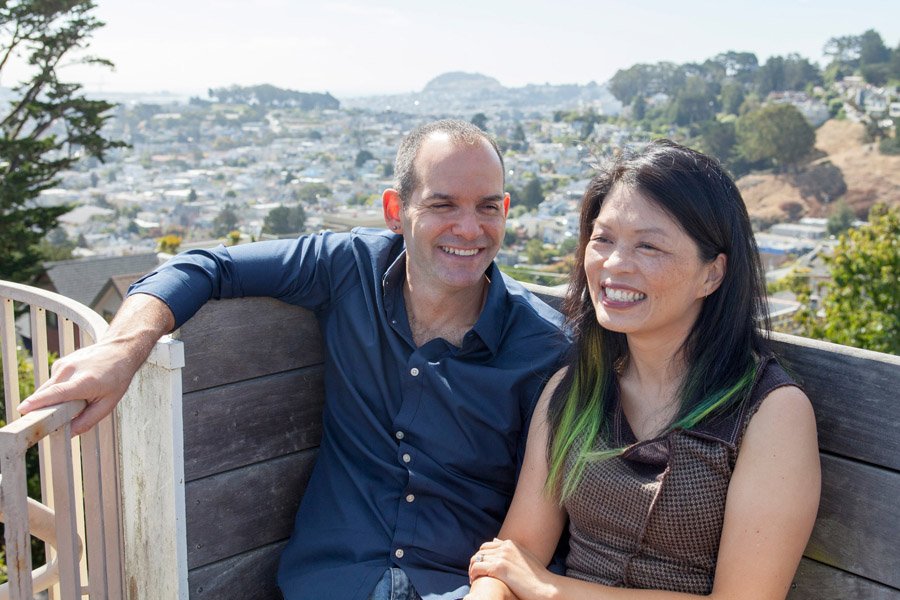
A Life That Moves Between Two Worlds
Pam Ling stands at an unusual crossroads. On one side is clinical medicine, with its hard facts, long training, and relentless responsibility. On the other side is public visibility, where a person can become familiar to millions for a few memorable months and then spend decades building a life far from the spotlight. In Pam Ling’s case, those two paths did not cancel each other out. They sharpened one another.
Her story has the shape of a bridge. One end begins in Los Angeles, where ambition and reinvention often feel like part of the air. The other reaches into the layered world of academic medicine at UCSF, where research, teaching, and policy can change the lives of people who will never know the names of the scientists behind the work. Between those ends lies a career that has never been content to stay in one lane. Pam Ling has been a medical student, a television cast member, a physician, a researcher, a professor, a public health strategist, and a steady presence in a field that often needs patience more than applause.
Education as a Foundation, Not a Badge
Pam Ling’s education reflects a mind drawn to both precision and scale. Harvard gave her a broad intellectual base. UCSF gave her the tools of medicine. Berkeley added public health, which is where the lens widens from the individual patient to the larger population. That combination matters. A doctor can treat a person in a room, but public health asks why that person arrived there in the first place, and how others might be spared the same path.
This is where Ling’s career begins to show its deeper logic. Her work has never been about collecting credentials like trophies on a shelf. Instead, each stage seems to have been chosen to answer a larger question: how do you reduce harm before it takes root? That question runs through her training in internal medicine, her interest in HIV prevention, and her later work on tobacco control. The pattern is clear once you look at it closely. She has spent years studying not just disease, but the systems that feed it.
Reality Television and a Very Real Turning Point
Pam Ling became known to a national audience in 1994 through The Real World: San Francisco. In the culture of the time, the show was part social experiment, part cultural mirror, and part emotional pressure cooker. Seven young adults were placed in close quarters and expected to live in public view. The result was often messy, sometimes tense, and occasionally revealing in ways television had not really attempted before.
Ling’s role in that environment was notable because she did not present herself like a performer trying to dominate the frame. She came across as observant and composed, a person whose calm could be felt even when the room was not calm at all. That mattered. In a cast shaped by conflict and strong personalities, restraint can be its own kind of force. It can steady the air in a house full of static.
The show’s lasting cultural significance also came from its engagement with HIV and AIDS, especially through Pedro Zamora. That context gave the season a moral gravity unusual for reality television at the time. For Pam Ling, the experience seems to have been more than a brief brush with fame. It was part of a larger human story, one that helped define the arc of her public life. She entered the show as a medical student. She left it with a national profile, a set of lifelong relationships, and a clearer sense of how public attention can intersect with advocacy.
Judd Winick and a Marriage Built Away from the Noise
One of the most enduring parts of Pam Ling’s public story is her marriage to Judd Winick. Their relationship began in the aftermath of the show and developed over time rather than arriving all at once like a headline. That slow build gives it a different texture. It feels lived in, not staged.
Their marriage has lasted because it appears to rest on shared history, mutual respect, and an instinct for privacy. In a culture that often rewards oversharing, they have drawn a boundary around their family life. That boundary is not a wall. It is more like a garden fence, one that protects what is tender without hiding the fact that life is growing there.
They have two children, and the family has kept details about them largely private. That choice says something important about how Pam Ling navigates public identity. Fame may have found her, but it did not define her. She has continued to build a home where work, parenting, and ordinary routines matter more than performance.
Tobacco Control as a Long Campaign Against Persuasion
Pam Ling’s professional work at UCSF has focused on tobacco control, especially the ways industries recruit new users and keep existing ones hooked. This is not only a scientific problem. It is also a problem of messaging, imagery, social pressure, and habit. Tobacco companies, and later the makers of e-cigarettes and vaping products, have often depended on the same old trick: make harm look modern, social, and harmless.
Ling’s research pushes back against that trick. Her work examines marketing strategies aimed at youth and young adults, investigates cessation approaches, and helps translate evidence into policy. That is careful work, but it is not passive work. It is an attempt to break a spell. The tobacco industry has long operated like a magician with smoke in one hand and distraction in the other. Researchers like Ling expose the mechanics behind the illusion.
What makes her role especially important is that she does not stop at diagnosis. She helps identify interventions that can be tested, measured, and used. That is where the work becomes practical. It turns from insight into leverage. A good public health policy can be like a well-placed wedge in a heavy door. It does not force the door open all at once, but it makes future movement possible.
Leadership at UCSF and the Weight of Credibility
In 2021, Pam Ling became Director of the UCSF Center for Tobacco Control Research and Education. Leadership in an academic setting is often misunderstood as a matter of title or prestige. In reality, it is closer to navigation. A director has to keep research moving, support younger scholars, maintain public relevance, and help connect evidence to action.
That role suits Ling because her career has always had both depth and steadiness. She is not built for theatrical declarations. She is built for accumulation, for the patient stacking of evidence until it becomes too solid to ignore. In fields like tobacco control, that kind of credibility is invaluable. Policy rarely changes because one loud voice demands it. It changes when a long series of careful voices finally shifts the ground.
Why Her Public Image Still Resonates
Pam Ling remains recognizable in part because her life contains an unusual blend of visibility and discretion. Many people first encountered her through television. Others know her through medicine and research. Those two audiences might seem separate, but they meet in the same person. That is what makes her interesting. She is not a celebrity who became a physician, nor a physician who merely passed through celebrity. She is someone who moved through both worlds and kept building.
Her public image endures because it is anchored in substance. She is associated with the early history of reality television, but she is not frozen there. She is associated with family life, but she is not reduced to it. She is associated with tobacco research, but the work extends beyond a single topic into broader questions about prevention, influence, and health equity.
The Shape of Her Work Today
Pam Ling’s current public presence is measured and professional. She appears in contexts tied to research, institutional leadership, and health policy, which fits the rest of her career. The through line is consistency. She has spent years working in a field where the rewards are often delayed and the victories are partial. That requires a certain temperament. It requires someone willing to keep pushing even when progress arrives in inches rather than miles.
Her story offers a useful reminder that a life can be widely seen without being widely exposed. It can contain public moments and still remain private at its core. It can move from a television set to a laboratory, from a national audience to a research agenda, from youthful visibility to mature authority. In that sense, Pam Ling is less a celebrity physician than a study in continuity, a person whose early visibility became one more tool in a much larger effort to improve health, shape policy, and resist the easy seductions of harm
The Modern Writers Toolkit For Turning Ideas Into Publishable Stories
When Your Pet Turns Dinner Into A Detective Mystery
Making Diaphragm Birth Control Work For You
How Driver Responsibility Shapes An Injury Claim
When Your Utah Website Needs More Than A Fresh Coat Of Content