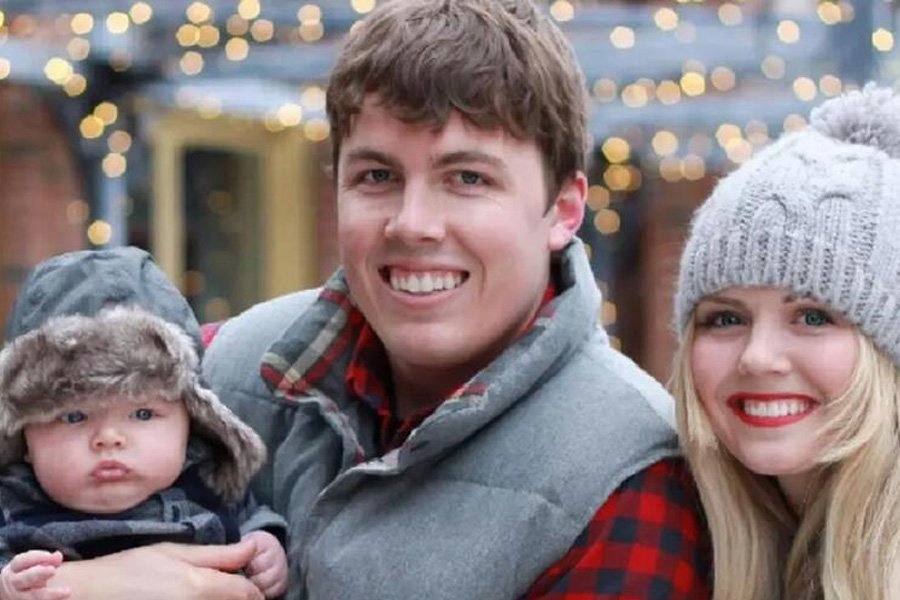
A child in a world of helmets and noise
I watch how childhood breathes differently inside a career that talks loudly. For Kyler Robert Moore the rhythm of family life is measured by suitcases, press lights, and the slow folding of privacy into public moments. He is not a headline. He is the small human who arrives at introductions and photographs, who stands beside the adults who steer careers and franchises. Yet his presence matters in ways that reporters rarely record. It matters because it ties the public ritual back to a private life. I think of that tether as a thin rope of ordinary moments that keeps a family steady while the rest of the world watches.
The anatomy of a public appearance
I have sat through enough formal introductions to know they are both performance and proof. A team introduction is choreography: the coach speaks, the cameras capture, and the family stands like punctuation. When Kyler shows up for those photographs the image does two things. It humanizes the appointment. It announces that choices about careers ripple through people who will not be judged on wins and losses. Yet the photograph is not the whole story. Behind it are breakfasts rushed before flights, favorite toys tucked into duffel bags, and playlists replayed to help a child sleep. Those details are invisible, and that is how many families prefer it.
Privacy as a daily practice
Privacy is not a single act. It is a thousand small edits. Parents say no to questions that would pull a child into stories they did not choose. They teach cameras to be tolerated instead of invited. For a child like Kyler Robert Moore, privacy looks like a deliberate architecture – school schedules that are protected, friends who know him as a classmate rather than as a public figure relative, and rules about social media that keep a young life from being cataloged before it has formed. I admire the discipline behind such decisions. Raising a kid under public scrutiny is a craft that asks for restraint from adults who are rewarded for visibility.
Traveling with the team, holding to a home
Professional sports ask families to move with momentum. New cities, new routines, new faces at the dinner table. Those changes are not only logistic. They are social weather that alters how children make friends, how they see their own continuity. Kyler has experienced that weather. Each hotel room, new school, and sideline introduces a fresh vocabulary of belonging. Yet children adapt. They find their own steady things – a favorite cereal, a nickname, a hidden corner in a library. These small anchors are the soft scaffolding that supports identity when everything else feels transient.
The child who is not a brand
There is pressure to turn the child of a public professional into a public person. I have watched that impulse in many settings. It is easier for outlets to attach narrative labels than to leave silence. But Kyler is not a brand. He is a person in formation. That distinction matters because naming a child as a public asset can change expectations and opportunities in ways that are not always healthy. Keeping a child unbranded preserves options – the freedom to choose a path outside of sports, to choose one inside of it, or to search for something in between. I support the idea of letting children choose because it honors their agency.
Rituals that last beyond the stadium
Families who live inside professional life invent rituals that belong only to them. I imagine Kyler with small routines that will outlast every season: a joke told in the car before practice, a bedtime story repeated to the same cadence, a shared gesture that means everything and nothing to the rest of the world. Those rituals are the durable currency of childhood in a public orbit. They convert fleeting time into memory. They shape character more than the visible events do.
How adults manage the spotlight
Adults tend to overestimate how much children notice. I have learned that children are keen observers but selective in what they internalize. Parents who work in the public eye balance transparency with protection. They decide when to explain, when to shield, and when to model calm. That labor – the emotional labor of raising a child under a microscope – is quiet and relentless. It is the work of translating complex professional changes into language a child can hold. For Kyler, that translation likely involved small explanations, honest reassurances, and the steady presence of parents who make family the safe shore.
The unrecorded curriculum of childhood
A child growing up around coaches and mentors learns lessons no classroom can teach. I sense that Kyler absorbs patterns of leadership, of language about effort, and of how adults handle losing and winning. He learns to sit still for long speeches, to listen while others talk, and perhaps to find his own ways of being at ease in noisy rooms. These are intangible skills that shape temperament. They do not make him a public figure. They make him more resilient.
FAQ
Who is Kyler Robert Moore?
Kyler Robert Moore is a child within a family known for professional coaching. His presence at formal public events is occasional and tied to family introductions. He is not profiled independently in public life and is raised with attention to privacy.
How visible is Kyler in the public sphere?
Kyler appears in family photographs and at formal team events. Those appearances are moments rather than a continuous public life. Outside of these occasions his daily life remains private, shaped by family routines and the choices of his parents.
Does Kyler have his own social media or public career?
No public record or independent public profile for Kyler has been created or promoted. His guardians appear to manage public exposure so that he can grow without a public persona attached to his name.
How does a coaching job change affect a child like Kyler?
A coaching move changes rhythms – new city, new schools, new neighbors. It can also bring more predictable family schedules in some ways and more instability in others. For a child it is both disruption and opportunity. The practical effects are softened when parents create small, reliable rituals that travel with them.
What are the ethical considerations about reporting on children of public figures?
Reporting on children requires restraint. The ethical choice is to respect privacy and avoid turning a child into content. Children cannot consent to the long tail of public attention, and protecting their development is a responsibility that extends beyond any news cycle.
Could Kyler follow a career in sports later in life?
He could, or he could choose something entirely different. Growing up in a coaching family exposes a child to one world, but exposure is not destiny. The best gift adults can give is choice and a stable foundation from which a child can decide his own path.