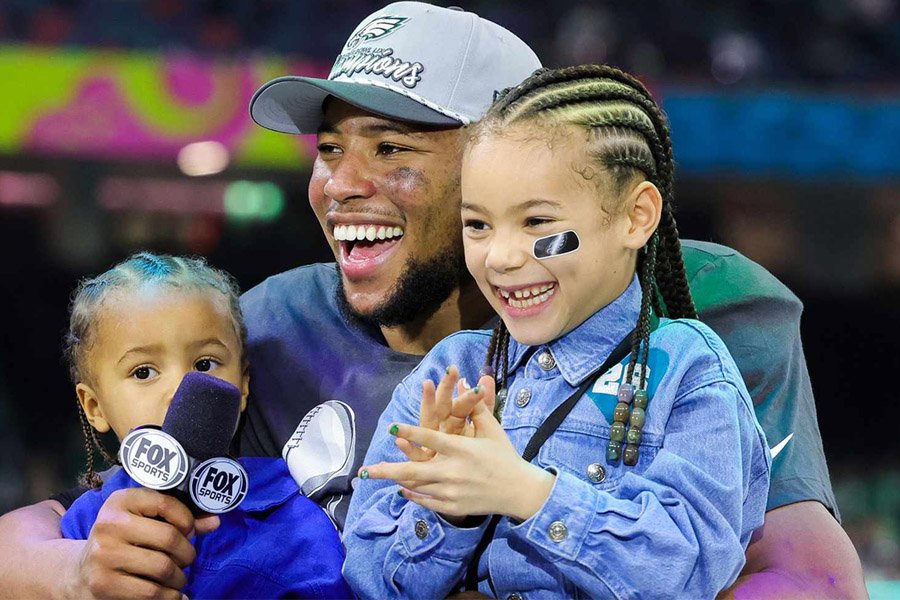
A small presence with outsized gravity
I have watched sports stories for years, and there is a pattern I keep returning to: the human detail that changes how we see everything else. In the middle of stadium lights, broadcast booths, and headline statistics, a tiny gesture can become the axis on which a narrative turns. That is what I see when I think about the little girl at the end of postgame hugs, the one who has only ever been herself and who, by virtue of being family, reshapes the way we read triumph and pressure.
She is not a public person in the way adults on payrolls are. She is a child whose presence reframes adult performance. That contrast is part of the story I want to follow. The handshake, the quick exchange before kickoff, a voicemail left in a moment thick with expectation; these are not just viral moments. They are vernacular family language translated for millions. They tell me about priorities, about calm in the middle of extreme noise, about what a person chooses to bring onto the field and what he keeps off camera.
The family orbit
Saquon Barkley and Anna Congdon are the gravitational forces. Their choices about visibility, ritual, and privacy ripple outward. There is also the younger sibling, Saquon Barkley Jr., who will inherit the same family script in his own time. I mention them here only once in the formal way that the world tends to catalog people. After that, I describe what they represent to me: steadiness, an insistence on family as more than a PR line, and the kind of disciplined affection you see when adults make small, consistent gestures for children.
The rest of my voice in this piece comes from observation and imagination about the texture of their days. I picture routines that are ordinary: shoes left half untied, a small hand tugging a sleeve, a father who practices the same handshake because repetition becomes ritual in an unpredictable life. I do not need to list every public appearance to argue that the family has intentionally curated what is shared and what remains private. That curation, to me, reads like care.
What ritual does in the public eye
Ritual condenses complexity. A handshake lasting a second says more than a thousand-word feature ever could. For a professional athlete, rituals are practical. They steady nerves. They focus attention. But when a ritual includes a child, its meaning multiplies. It becomes a way of translating adulthood into a language the very young can hear. It becomes a lesson in presence.
I often think about the economy of attention in celebrity life. Attention is currency. Parents who are also public figures must decide when to spend it and when to save it. I admire the way some families treat children as aspects of life to be protected, not as assets to be amplified. I can hear the internal negotiations in every published photo: a decision to show a smile, a choice to let a hug be photographed. Those decisions shape how the child is known by the public well before they can choose their own path.
The privacy paradox
I live with competing impulses. I want to know everything the world knows, and I also want to stop the world from knowing anything at all. That tension becomes its own narrative when we talk about kids of prominent adults. On one hand, visible moments tether a celebrity to the most human parts of life. On the other hand, excessive exposure drafts a life for someone who did not sign up to be a public figure.
For me, the right line is a thin one. I value the warm details that reveal character. I do not value the commodification of a child. Watching families who navigate this terrain with restraint offers a map for others. They show how to let audiences into tender moments without building a public biography around an unconsenting person. That restraint matters. It is a kind of generosity. It is also wise.
Financial and cultural gravity
When a high profile athlete signs a major contract, the ripples reach far beyond the ledger. They change opportunities. They move house. They alter education possibilities. They shape the kinds of interactions families have with the institutions around them.
I think about stability. Big earnings can create buffer zones that allow parents to make choices from security rather than scarcity. They can buy time. They can allow a family to say no to certain invitations and yes to deliberate experiences. But money does not solve the central problem of childhood in the spotlight. It cannot replace the need for boundaries or the slow work of teaching a small person how to be themselves when cameras are present.
There is also cultural gravity. When athletes and their families accept the public gaze on their own terms, they influence how fans see parenthood. They model tenderness as a complement to competitiveness. That matters in a world that often isolates emotion from professionalism. I like that image. I return to it because it feels useful.
The sibling factor
Young brothers and sisters grow into roles before they know what the roles mean. Being a sibling of someone who gets cheered in stadiums is a quiet apprenticeship in public life. I imagine moments of ordinary sibling rivalry, of shared jokes, of toys left on the couch. Those tiny acts will always be what matters most.
I also imagine lessons taught without speeches. Seeing a parent return to the arms of family after a tense game teaches a child about proportional responses to both loss and success. Those are lessons I do not think get enough attention when people analyze celebrity lives.
FAQ
Who is Jada Clare Barkley?
I am talking about a child born into a family whose public life is tied to professional sport. She appears in brief, affectionate moments at games and family events. Those appearances are small windows, not a biography.
Who are her parents?
Her parents are a professional athlete and his partner. They work to keep the child anchored in normalcy while living in a life that draws attention.
Does she have siblings?
Yes. A younger brother arrived in the household in 2022. The dynamic between siblings is a private, lived thing that the public can only glimpse.
Is she featured often at games?
Occasionally. The family shares selected moments. Those are chosen carefully, like a curated album.
Did she leave a message before a major game?
A small, encouraging message was shared publicly ahead of an important game. It was a humanizing moment in an otherwise highly scripted week.
Are there details about her school or address?
No. The family keeps those private. That privacy is intentional and, in my view, important for the healthy unfolding of a child.